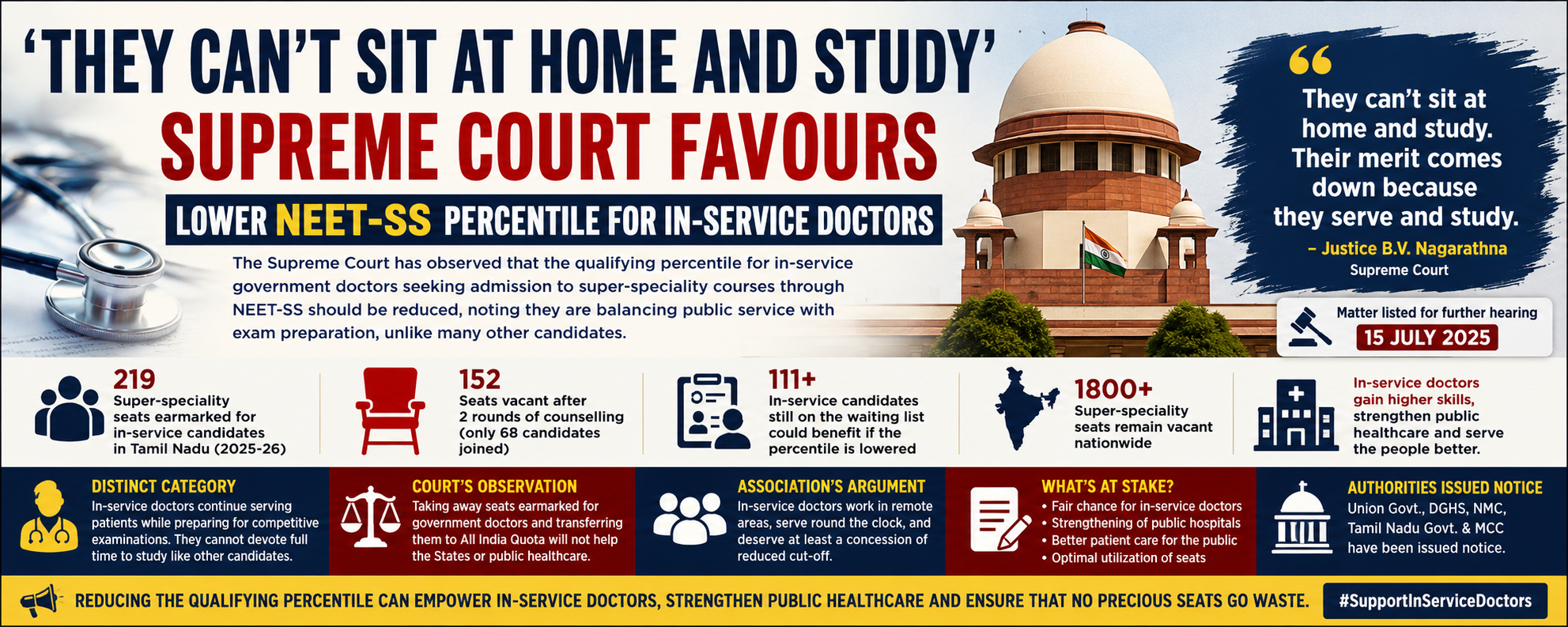
The Supreme Court has made an important observation in favour of in-service government doctors seeking admission to super-speciality medical courses through NEET-SS. The Court noted that the qualifying percentile for in-service doctors should be reduced because these doctors are balancing public service with examination preparation, unlike many other candidates who may have more dedicated study time.
The observation came during the hearing of a plea challenging the proposed diversion of vacant super-speciality seats reserved for in-service doctors in Tamil Nadu to the All India Quota. The issue has created serious concern among government doctors, NEET-SS aspirants and medical counselling stakeholders.
Why the Matter Is Important
Tamil Nadu had reportedly earmarked 219 super-speciality seats for in-service candidates for the 2025–26 academic year. After two rounds of counselling, only 68 candidates had joined, leaving 152 seats vacant.
The concern raised before the Court was that if these vacant seats are transferred to the All India Quota before a decision is taken on reducing the qualifying percentile, many in-service government doctors may lose an opportunity to pursue super-speciality education.
According to the petitioners, more than 111 in-service candidates are still on the waiting list and could become eligible if the NEET-SS qualifying percentile is reduced.
Supreme Court’s Observation
A Bench of Justice B.V. Nagarathna and Justice Joymalya Bagchi issued notice to the Union Government, Director General of Health Services, National Medical Commission, Tamil Nadu Government and Medical Counselling Committee, among others.
Justice Nagarathna questioned the logic behind taking away seats that were specifically earmarked for in-service doctors and transferring them to the All India Quota.
The Court observed that government doctors serving in state hospitals are working for the people of the state. These seats were earmarked to help such doctors gain higher skills and ultimately serve public healthcare better.
The Court’s strong observation was:
“They can’t sit at home and study. Their merit comes down because they serve and study.”
This remark highlights a practical reality often ignored in competitive medical examinations. In-service doctors are not full-time aspirants. They are actively serving patients, working in government hospitals, often in remote or high-pressure areas, while also preparing for one of the toughest medical entrance examinations.
In-Service Doctors Are a Distinct Category
The Court underlined that in-service doctors form a distinct category because they continue serving the public while preparing for competitive examinations.
Unlike candidates who can devote full time to exam preparation, government doctors must manage hospital duties, emergency responsibilities, patient care and public health work along with studies.
This is why the Court appeared to support the idea that a reduced qualifying percentile for in-service doctors may be justified.
Justice Nagarathna reportedly observed that government doctors are an essential part of the public health infrastructure. If they acquire super-speciality skills, they can serve public health better.
Public Health Angle
The issue is not only about individual admission rights. It is also about the strength of public healthcare.
When government doctors get super-speciality training, the benefit goes back to the public system. A doctor trained in a super-speciality branch can serve patients in government hospitals, district centres and public health institutions.
This is especially important in a country where access to private super-speciality care is often expensive and unaffordable for many families.
The Court’s observation raises an important policy question: if seats reserved for in-service government doctors are moved away before giving them a fair chance, does it weaken the public healthcare system?
Argument of Tamil Nadu Medical Officers Association
Appearing for the Tamil Nadu Medical Officers Association, senior advocate P. Wilson argued that transferring the unfilled seats to the All India Quota before a final decision on lowering the percentile would adversely affect government doctors and weaken Tamil Nadu’s public healthcare system.
The association argued that in-service doctors often work in remote areas and continue serving patients round the clock while pursuing higher qualifications. Therefore, they should get at least the concession of a reduced cut-off.
The petition also pointed out that qualifying percentiles in NEET-SS had been reduced in previous academic years, creating a legitimate expectation among candidates that they may also be considered if a similar reduction is granted this year.
National Impact Beyond Tamil Nadu
The Court clarified that it was not modifying earlier directions issued by a co-ordinate Bench in a related matter concerning vacant super-speciality seats. However, Justice Nagarathna stressed that any reduction in the qualifying percentile would benefit in-service candidates across the country, not only those in Tamil Nadu.
This is a crucial point. The matter may have started from Tamil Nadu’s in-service quota seats, but the larger question affects government doctors across India.
If the qualifying percentile is reduced, in-service doctors from multiple states may benefit. This could help fill more super-speciality seats and strengthen public healthcare capacity.
Vacant Seats and Counselling Concerns
The petitioners also pointed out that nearly 1,800 super-speciality seats remain vacant nationwide. In such a situation, transferring 152 Tamil Nadu seats to the All India Quota may not be necessary if the real problem is candidate eligibility due to percentile criteria.
The bigger question is whether valuable super-speciality seats should remain vacant or whether eligible in-service doctors should be given a fair chance through a reduced qualifying percentile.
Medical seats, especially super-speciality seats, are national assets. Every vacant seat means one less specialist doctor entering the healthcare system.
What Happens Next?
The matter has been listed for further hearing on July 15. Notices have been issued to key authorities including the Union Government, DGHS, NMC, Tamil Nadu Government and MCC.
The final decision will be important for:
NEET-SS aspirants
In-service government doctors
Tamil Nadu super-speciality counselling
All India Quota seat distribution
Public healthcare institutions
Future policy on reduced qualifying percentile
ICCC Bharat View
This case once again shows why medical counselling needs timely clarity and balanced policy decisions.
In-service government doctors are not ordinary candidates sitting only for exam preparation. They are working doctors serving patients and public hospitals while also trying to upgrade their qualifications.
If such doctors acquire super-speciality skills, the benefit goes directly to public healthcare.
At the same time, counselling authorities must ensure that no seat remains unnecessarily vacant. A clear policy decision on qualifying percentile, seat conversion and counselling schedule is necessary so that doctors are not kept waiting and seats are not wasted.
The Supreme Court’s observation rightly brings attention to the reality of in-service doctors: they serve and study at the same time.
Their effort deserves recognition.
Conclusion
The Supreme Court’s remark — “They can’t sit at home and study” — reflects the real struggle of in-service government doctors preparing for NEET-SS while continuing public duty.
The case is not only about Tamil Nadu’s 152 vacant seats. It is about fairness, public health, medical education policy and the need to protect super-speciality seats from going vacant.
If qualifying percentile reduction can help eligible in-service doctors enter super-speciality courses, it may strengthen government hospitals and improve patient care.
The upcoming hearing will be closely watched by NEET-SS aspirants, government doctors and medical education stakeholders across India.