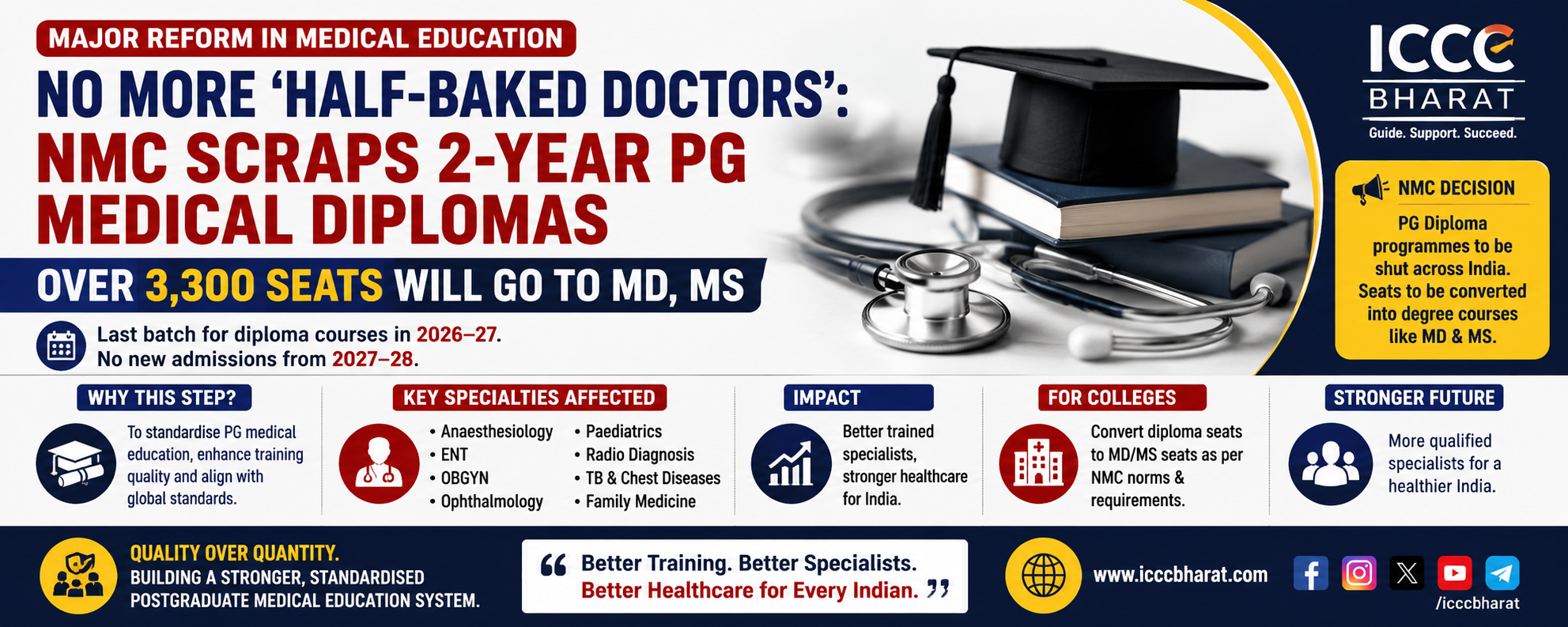
The National Medical Commission has taken a major decision to end two-year postgraduate medical diploma programmes across India after the 2026–27 academic year. According to the latest update, the upcoming 2026–27 batch will be the final batch admitted to PG medical diploma courses. From 2027–28 onwards, no new students will be admitted to these diploma programmes.
Instead, the seats currently running under diploma courses will be converted into regular MD/MS postgraduate degree seats, provided the concerned medical colleges and hospitals fulfil the required regulatory conditions.
This is a significant reform in postgraduate medical education because more than 3,300 diploma seats across medical colleges are expected to move towards degree courses like MD and MS.
Why NMC Is Ending PG Medical Diplomas
The NMC’s move is aimed at standardising postgraduate medical education and improving the quality and recognition of specialist training in India.
For many years, PG medical diploma courses existed alongside MD/MS degree courses. Both were used to produce specialists in different medical branches. However, diploma courses were shorter in duration and often did not carry the same recognition, academic weight or career value as degree programmes.
With medical education becoming more standardised and specialist training becoming more important, the regulator appears to have taken the view that PG diploma courses have outlived their original purpose.
The new direction is clear: India needs fully trained postgraduate specialists, not a parallel system where some students receive shorter diploma training while others pursue full degree programmes.
Final Admission Round in 2026–27
The NMC has allowed one final round of admission to PG diploma courses for the 2026–27 academic year. After that, these seats will be shifted to MD/MS courses.
This means 2026–27 will be the last chance for admissions into these diploma programmes. From 2027–28, fresh admissions to the two-year PG diploma courses will stop.
Medical colleges and hospitals still running diploma courses have been advised to submit proposals for conversion of diploma seats into degree seats such as MD and MS.
Over 3,300 Seats Expected to Move to MD/MS
According to the reported data, around 3,323 PG diploma seats are still available across several specialties and institutions.
These seats are spread across important clinical branches such as:
Anaesthesiology
ENT
Family Medicine
Obstetrics and Gynaecology
Ophthalmology
Paediatrics
Radio Diagnosis
Tuberculosis and Chest Diseases
Many states have already discontinued diploma seats completely. States and Union Territories such as Delhi, Maharashtra, Uttar Pradesh, Uttarakhand and Himachal Pradesh reportedly do not have diploma seats left. Other states still have seats that now need to be converted gradually into MD/MS programmes.
“No More Half-Baked Doctors”
One of the strongest arguments in favour of this move is that diploma students often receive less training time compared to MD/MS students.
Since PG medical diploma courses are shorter, some experts have argued that students hardly receive adequate specialist training before completing the course. This is where the phrase “half-baked doctors” has entered the debate.
The concern is not about the ability or hard work of diploma students. The concern is about the structure of the course itself.
If a medical graduate is being trained as a specialist, the training must be deep, structured, clinical and complete. Shorter training may not be enough in many branches where patient care requires high-level clinical exposure and decision-making.
Why Diploma Courses Were Useful Earlier
PG diploma courses were introduced and continued for a reason. At one time, India had a shortage of postgraduate doctors and specialists. Diploma courses helped create trained doctors faster, especially for rural and underserved areas.
In branches like Anaesthesia, Obstetrics and Gynaecology, Paediatrics, Ophthalmology and ENT, diploma doctors played an important role in healthcare delivery.
Many diploma holders served in district hospitals, rural centres and government healthcare institutions where specialist availability was limited.
However, the healthcare system has changed. India has been expanding MD/MS seats rapidly. With more degree seats being added every year, the need for two-year diploma programmes has reduced.
Expansion of PG Seats Changed the Situation
India has been increasing postgraduate medical seats at a fast pace. With thousands of new PG seats added in recent years, the shortage of postgraduate training opportunities is gradually reducing.
This expansion has made it possible to phase out diploma programmes and convert them into full degree courses.
If implemented properly, this move can increase the number of fully trained specialists in the country without wasting existing seat capacity.
Instead of losing diploma seats, the system can upgrade them into MD/MS seats.
What Colleges Need to Do Now
Medical colleges and hospitals that still run diploma programmes must now prepare for conversion.
However, conversion will not be automatic. Institutions must meet regulatory requirements related to:
Faculty availability
Clinical material
Hospital infrastructure
Bed strength
Equipment
Teaching facilities
Departmental workload
Compliance with NMC norms
The NMC has already been working on relaxing certain faculty and infrastructure norms to help colleges convert diploma seats into degree seats. But experts have warned that conversion must be done carefully.
If a diploma seat is converted into an MD/MS seat without adequate faculty, clinical exposure or infrastructure, the purpose of the reform will fail.
Quality Must Not Be Compromised
The most important part of this decision is quality control.
Converting diploma seats into degree seats should not become a numbers game. The country needs more specialists, but not at the cost of training quality.
Every MD/MS seat must have proper teaching, patient load, hands-on exposure, academic structure and clinical supervision.
The NMC must ensure that only those institutions that satisfy the required standards are allowed to upgrade diploma seats into degree seats.
Otherwise, the same problem will return in another form.
Impact on NEET PG Aspirants
This decision is important for NEET PG aspirants.
From 2027–28 onwards, students may see fewer or no diploma options in counselling. Instead, many of those seats may appear as MD/MS seats after conversion.
This can benefit students because MD/MS degrees generally offer better academic recognition, career growth, teaching eligibility and specialist status compared to diploma courses.
Students who previously considered diploma courses due to rank limitations may now have more opportunities in degree programmes, depending on how many seats are successfully converted.
Impact on Medical Colleges
For medical colleges, this is both an opportunity and a challenge.
The opportunity is that diploma seats can be upgraded into degree seats, improving the academic profile of the institution.
The challenge is that colleges must meet NMC requirements. They may need to strengthen departments, appoint faculty, improve hospital services and show adequate clinical material.
Institutions that fail to meet norms may not be able to convert their seats immediately.
Impact on Public Healthcare
If implemented properly, this reform can improve public healthcare in the long run.
India needs more specialists in government hospitals, district hospitals and rural healthcare centres. MD/MS-trained doctors can strengthen specialist services in areas such as emergency care, maternal health, child health, surgery, anaesthesia, chest medicine and diagnostics.
However, the government must ensure that the conversion of diploma seats does not reduce specialist availability in rural areas. Earlier, diploma doctors often served in rural postings. The new degree-based system must continue to support public health needs.
ICCC Bharat View
NMC’s decision to end two-year PG medical diplomas is a bold step towards standardising postgraduate medical education.
A doctor entering specialist practice must receive full, structured and recognised training. In that sense, converting diploma seats into MD/MS seats is a positive move.
But implementation is the key.
The regulator must not allow weak conversion merely to increase seat numbers. Each converted MD/MS seat must be backed by real infrastructure, proper faculty and enough clinical exposure.
Students should also be careful while analysing future NEET PG counselling. Diploma seats may disappear, and converted degree seats may change branch-wise and college-wise seat availability.
This reform can help medical education only if it protects both quality and opportunity.
Conclusion
The NMC’s decision marks the end of an old chapter in postgraduate medical education. Two-year PG medical diploma courses will now be phased out after the 2026–27 batch, and more than 3,300 seats are expected to move towards MD/MS degree programmes.
This may improve the quality, recognition and standardisation of specialist training in India.
But the success of this reform will depend on strict implementation, transparent seat conversion, proper infrastructure and strong academic supervision.
India does not only need more doctors. India needs well-trained specialists.
If diploma seats are converted responsibly into MD/MS seats, this decision can become a major step forward for medical education and healthcare in the country.