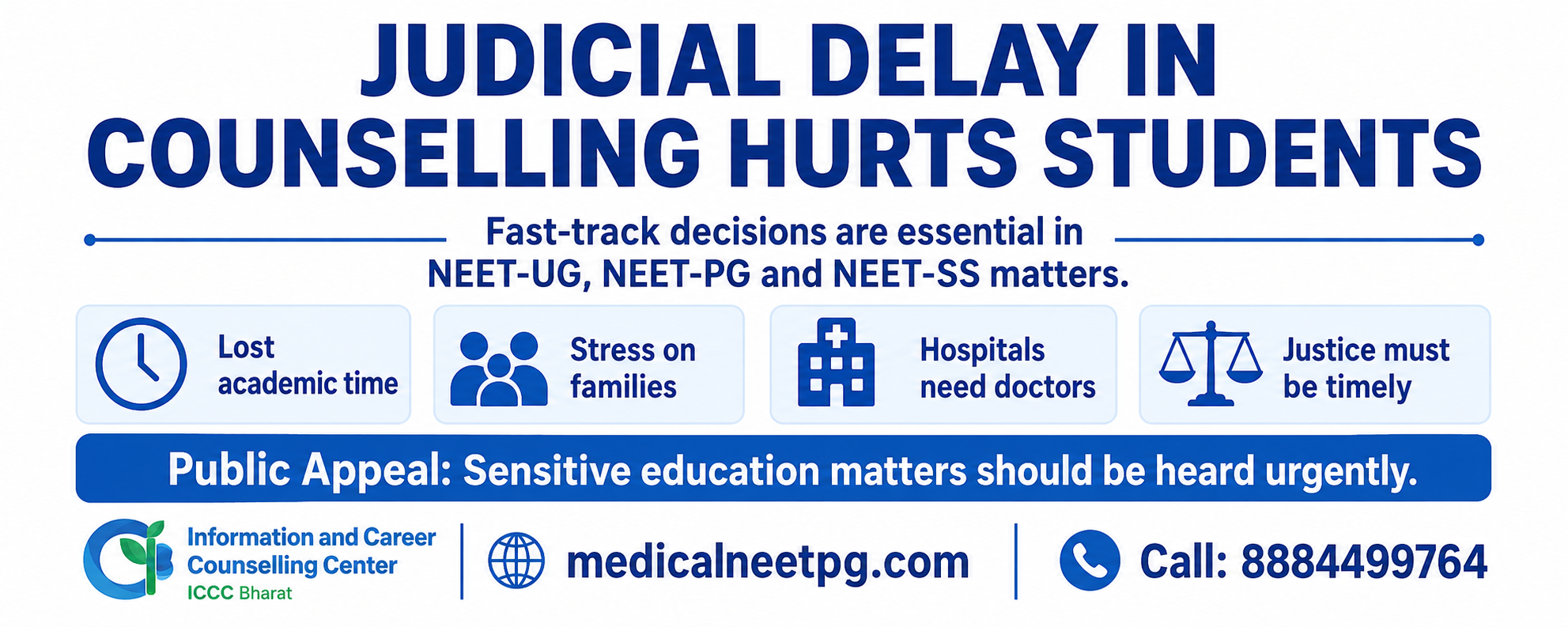
In a strong democracy, the judiciary is the final hope for citizens when administrative decisions, policy confusion, or institutional failures affect their rights. In the field of education, especially professional education, courts have played a very important role in protecting students from arbitrary decisions, unfair rules, delayed approvals, and defective counselling processes.
However, one serious question now needs national attention:
When a court case directly stops or delays an ongoing counselling process, should it be treated as a routine matter, or should it be treated as an emergency?
This question is especially important in admissions such as NEET-UG, NEET-PG, NEET-SS, engineering counselling, medical counselling, and other professional courses, where time is not just a procedural factor. Time is the foundation of the entire academic year.
A delay of a few days may disturb counselling. A delay of a few weeks may disturb colleges and state authorities. But a delay of one or two months can destroy the planning of thousands of students, families, institutions and hospitals.
Education Counselling Is Time-Sensitive
Unlike ordinary disputes, admission counselling matters are bound by strict academic calendars. Every round has a deadline. Every college has a joining date. Every student has to plan travel, documents, finance, resignation from job, hostel arrangements and reporting formalities.
In medical admissions, the situation is even more serious. NEET-PG and NEET-SS candidates are not just students. Many of them are already qualified doctors. Some are working in hospitals. Some have resigned from their jobs. Some are waiting for senior residency. Some are shifting from one state to another. Some have families dependent on them.
When counselling is delayed because of a pending court matter, the impact is not only academic. It becomes personal, financial, psychological and professional.
The uploaded article rightly highlights that in professional medical and engineering admissions, time is not merely a variable; it is everything. A delay of even a couple of weeks can disrupt tightly bound academic calendars, while prolonged delays can derail thousands of students and institutions.
NEET-SS and the Healthcare Impact
The issue becomes even more critical in NEET-SS counselling. Super-speciality aspirants are future cardiologists, neurologists, oncologists, nephrologists, gastroenterologists, urologists, critical care specialists and other highly trained doctors.
If their counselling is delayed, hospitals suffer. Departments face shortages. Existing doctors are overburdened. Patients suffer due to lack of specialist manpower.
This means a counselling delay in NEET-SS is not only a student issue. It becomes a public healthcare issue.
If a doctor receives an emergency patient, the doctor cannot say, “I will examine this case after two months.” The doctor must act immediately. Similarly, when a legal matter affects thousands of doctors, hospitals, patients and academic systems, the judicial process must also show urgency.
This is not to question the authority or dignity of the judiciary. The judiciary remains one of the strongest pillars of democracy. But in time-bound education matters, judicial sensitivity and speed are equally important.
Justice Delayed Can Become an Academic Year Lost
In normal civil matters, delay may cause inconvenience. But in admission counselling, delay can cause irreversible damage.
A student may lose one full academic year.
A doctor may lose employment.
A family may face financial pressure.
A college may lose students.
A hospital may lose manpower.
A state counselling authority may be forced to stop its own process.
A national academic calendar may collapse.
That is why the principle of “justice delayed is justice denied” becomes even more serious in education matters. In counselling matters, justice delayed can become an academic year denied.
The uploaded article also states that when counselling is halted without a clear expedited roadmap, central and state counselling schedules get disturbed, students lose trust, and institutions remain unable to plan academic sessions or clinical duties.
Courts Must Protect Students Through Speed
The judiciary has always protected students’ rights in many important cases. But today, the nature of education litigation has changed. National-level entrance examinations involve lakhs of students. Counselling disputes can affect entire batches. Seat matrix cases can stop multiple rounds. Reservation disputes can delay admissions. Institutional approval disputes can disturb state and national schedules.
Therefore, education counselling cases need a special approach.
If a matter affects an ongoing counselling process, it should not be kept pending like a routine matter. It should be heard urgently. If a final order cannot be passed immediately, at least an interim direction should be given so that unaffected students and seats do not suffer.
For example, if only a small number of seats are under dispute, the court may consider keeping those seats subject to final outcome while allowing the remaining counselling to proceed. This can protect both legal rights and the larger student community.
Need for a Fast-Track Judicial Protocol
India needs a clear fast-track mechanism for education admission disputes.
Any case should be treated as urgent if:
An active counselling process is stopped.
Admission deadlines are affected.
Thousands of students are waiting.
Medical or healthcare manpower is involved.
State and central counselling schedules are disturbed.
Academic year loss is possible.
In such cases, the matter should ideally be heard and resolved within a fixed time frame, such as 7 to 15 days. If the matter is complicated, the court may issue interim directions within that period.
A simple model can be:
Active Counselling Halt → Emergency Listing → Hearing within 7–15 Days → Final Order or Interim Relief
This will protect students from uncertainty and also preserve public trust in the system.
Administrative Authorities Also Must Act Responsibly
While judicial urgency is important, the entire responsibility cannot be placed only on courts. Government bodies, counselling authorities, examination boards and regulatory commissions must also act with seriousness.
Authorities must ensure:
Clear counselling schedules.
Accurate seat matrices.
Timely correction of errors.
Proper communication with students.
Coordination between central and state counselling.
Immediate legal response when cases are filed.
Transparent vacancy and admission data.
Many education cases reach courts because administrative authorities fail to act clearly, fairly or on time. If authorities work properly, many disputes can be avoided.
Why Public Confidence Matters
Students and parents approach courts with hope. They believe that the judiciary will protect them when the system fails. But when urgent student matters remain pending for weeks or months, frustration grows. Students begin to feel helpless. Parents lose confidence. Colleges remain confused. State authorities are forced to wait.
Public confidence in the judiciary is strengthened not only by correct decisions, but also by timely decisions.
In education counselling, delay itself can become injustice.
Conclusion
Education counselling matters, especially those affecting NEET-UG, NEET-PG, NEET-SS, engineering admissions and other national-level professional courses, must be treated with urgency.
The purpose is not to question the judiciary. The purpose is to request a more time-sensitive and student-sensitive approach.
When thousands of students are waiting, when doctors are unable to join, when hospitals are facing manpower shortage, when colleges cannot start academic sessions, and when families are suffering financially and mentally, such cases must be treated as legal emergencies.
India needs a fast-track judicial protocol for education counselling disputes.
Because in education admissions, justice delayed is not only justice delayed — it is a lost seat, a lost year, a lost career opportunity, and a national loss