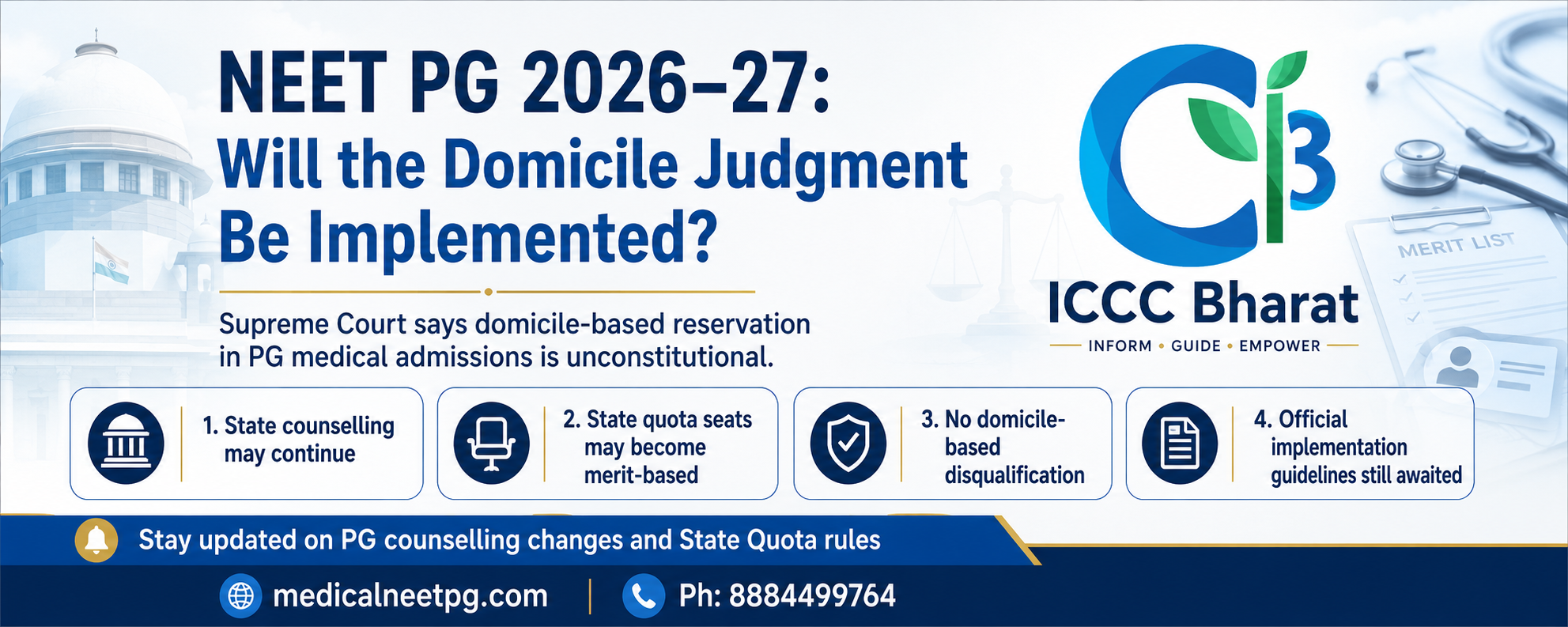
The Supreme Court of India’s judgment in Dr. Tanvi Behl v. Shrey Goel & Ors. has created one of the biggest debates in postgraduate medical admissions. The Court held that domicile-based or residence-based reservation in PG medical courses is constitutionally impermissible, as it violates the Right to Equality under Article 14 of the Constitution. The judgment clarified that India has only one domicile — the Domicile of India — and there is no separate concept of state domicile in the Indian constitutional framework.
The key question now is: Will this judgment be implemented in NEET PG 2026–27 counselling across India?
As of today, there is no uniform public implementation notice from NMC, MCC or DGHS clearly stating how every state must modify its NEET PG State Quota counselling rules for 2026–27. However, reports indicate that the Centre has sought feedback from states, including Karnataka, on the possible implications of implementing the Supreme Court order.
What Did the Supreme Court Say?
The Supreme Court clearly differentiated between MBBS and PG medical admissions. For undergraduate medical courses like MBBS, some level of residence-based reservation may be justified because states invest in creating medical colleges, infrastructure and local healthcare systems.
However, for postgraduate medical courses such as MD/MS, the Court took a stricter view. PG medical education produces specialist doctors, and at this level, merit and national standards become more important than regional preference. The Court observed that reservation at the higher level based on residence would violate Article 14.
The judgment also stated that all admissions to PG courses should be based on NEET merit, and state quota seats, apart from permissible institutional preference, must follow merit-based selection.
Will State Counselling Continue?
Yes, state counselling may still continue. But the major change could be in how the State Quota seats are filled.
Earlier, 50% of PG medical seats were filled through All India Quota counselling, while the remaining 50% were filled through state counselling authorities. In many states, these State Quota seats were practically reserved for domicile candidates or candidates who had studied MBBS in that state.
After the Supreme Court judgment, state counselling may continue, but domicile-based exclusion may not be legally sustainable. This means State Quota counselling may have to become more open, merit-based and accessible to eligible NEET PG candidates from across India.
In simple terms:
State counselling may remain, but state domicile restrictions in PG medical admissions may be removed or heavily modified.
What Might Happen Next?
If the judgment is implemented uniformly, the following changes may be seen in NEET PG 2026–27:
- State counselling will continue
States may still conduct counselling for their 50% State Quota seats. - No domicile-based disqualification
Candidates from outside a state may be allowed to compete for State Quota PG seats based on NEET PG merit, unless a legally valid institutional preference rule applies. - Institutional preference may continue within limits
The Supreme Court has earlier recognized reasonable institutional preference in PG medical admissions. This means candidates who completed MBBS from the same state or institution may still get some preference, but unlimited or 100% exclusion of outsiders may be challenged. - Category reservations may continue
SC, ST, OBC, EWS and PwD reservations may continue as per constitutional provisions and applicable state/central rules. The judgment primarily targets domicile/residence-based reservation, not constitutionally recognized social reservation. - Service bond policies may change
Some states link PG seats with local service bonds. If domicile rules are removed, states may redesign service bond rules to ensure doctors serve government institutions or local healthcare systems after PG. - State rules may face legal review
States that continue domicile-based restrictions may face court challenges from NEET PG aspirants.
Karnataka’s Concern
Karnataka has reportedly highlighted the possible impact of scrapping domicile-based reservation. The concern is that many PG seats under the government quota are presently available to local candidates or candidates connected to the state. If domicile quota is removed, these seats could become open to candidates from across India purely on NEET merit.
Karnataka has also raised concerns about the 371(J) special reservation for the Kalyana Karnataka region. Under this provision, a significant portion of seats is reserved for local candidates from educationally backward areas. The state has indicated that if domicile-based reservation is removed without proper clarity, local students may be affected.
This is why the Centre appears to be collecting opinions from states before deciding the next step.
Why Southern States Are Worried
Several southern states may be concerned because they have invested heavily in medical education infrastructure and have a large number of PG medical seats. If state quota seats are opened nationally, candidates from across India may compete for these seats.
States may argue that local students should get some protection because state governments spend public money on medical colleges and healthcare institutions. However, the Supreme Court’s reasoning is that such logic may apply to MBBS to some extent, but not to PG medical education, where specialist training must be governed by national merit and equality principles.
Will NEET PG 2026–27 Counselling Change Immediately?
This is the biggest uncertainty.
Legally, the Supreme Court judgment is binding under Article 141 of the Constitution. That means all authorities, including High Courts, states, universities and counselling agencies, are expected to follow the law declared by the Supreme Court.
However, in practical terms, implementation depends on whether NMC, MCC, DGHS and state counselling authorities issue clear revised guidelines before NEET PG 2026–27 counselling.
As of today, students should not assume that every state has already changed its rules. They should wait for official brochures, information bulletins and counselling notices. At the same time, if any state continues strict domicile-based exclusion, it may become legally questionable in light of the Supreme Court judgment.
Impact on NEET PG 2026–27 Aspirants
The impact may be very significant.
If implemented, students may get more opportunities across India. A candidate from one state may be able to apply for PG seats in another state without being rejected only because of domicile. This can increase competition in states with good clinical exposure, lower fees, more government seats or better institutions.
At the same time, local candidates may face higher competition in their own state quota seats. This may especially affect states with high demand and limited PG seats.
The competition may shift from domicile advantage to pure NEET PG merit.
Important Point: Past Admissions May Not Be Affected
The Supreme Court judgment reportedly protects admissions already granted under previous domicile-based systems. This means past admissions may not be disturbed. The main impact is expected on future counselling rules and admissions after the judgment.
What Students Should Do Now
NEET PG 2026–27 aspirants should closely track:
- NMC official notices
- MCC PG counselling bulletin
- State counselling brochures
- State quota eligibility rules
- Institutional preference clauses
- Service bond conditions
- Category reservation rules
- Any review petition or clarification from the Supreme Court or Centre
Students should not depend only on old state rules, because many rules may be revised after this judgment.
Conclusion
The Supreme Court’s judgment on domicile-based reservation in PG medical admissions may bring a major change in NEET PG 2026–27 counselling. State counselling may continue, but it may no longer function as a closed system only for domicile candidates.
If implemented, the new system may make PG medical admission more merit-based, more open and more aligned with the idea of “One Nation, One Domicile.” But until NMC, MCC, DGHS and state authorities issue final official guidelines, students must remain cautious and wait for verified updates.
The future of NEET PG 2026–27 State Quota counselling depends on one thing now: clear implementation guidelines from the authorities.
Without clarity, students will again face confusion, litigation and uncertainty. With clarity, India can move towards a transparent, merit-based and nationally fair PG medical admission system.