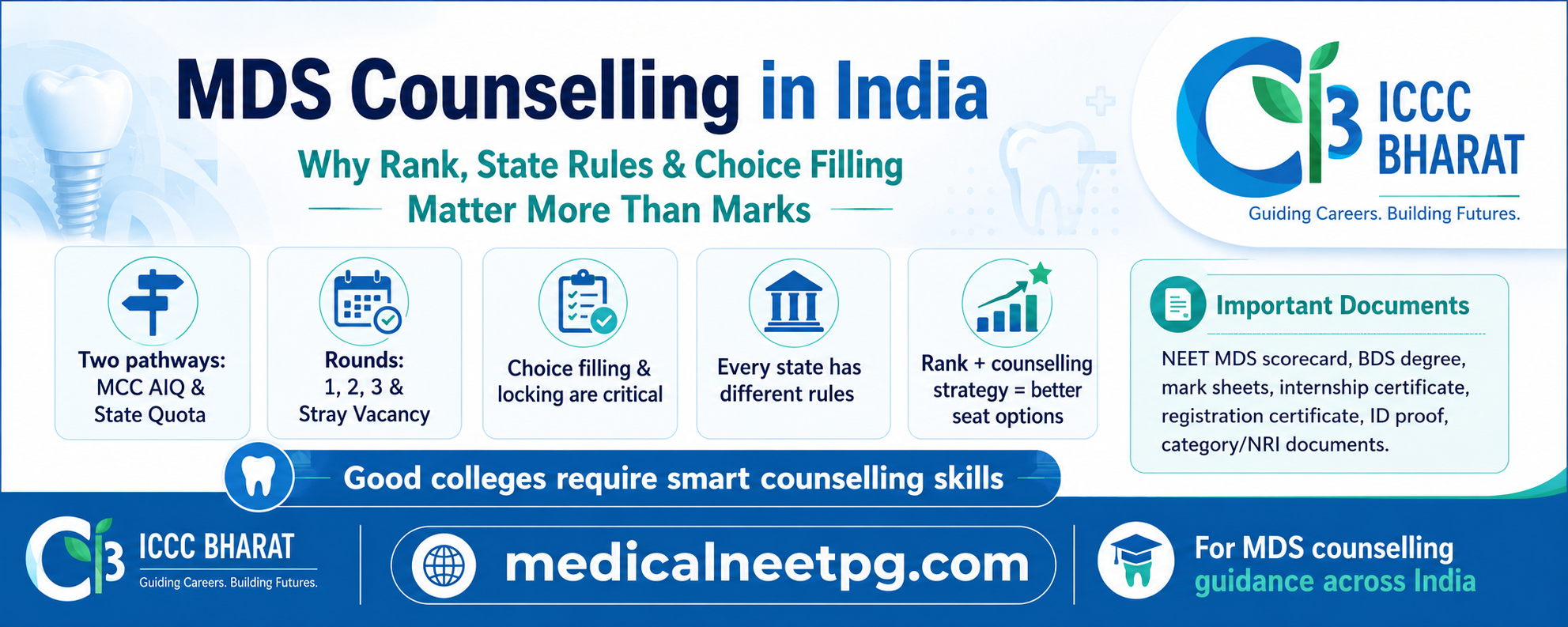
The Master of Dental Surgery (MDS) counselling process in India is a structured online admission system conducted after the NEET MDS result. Every year, thousands of BDS graduates participate in this process to secure admission in postgraduate dental courses across government, private, deemed and central institutions.
However, MDS counselling is not as simple as just scoring marks and waiting for allotment. It is a detailed process where rank, category, quota, state eligibility, branch preference, fee structure and choice filling strategy play a very important role.
Many students believe that marks alone decide admission. But in reality, NEET MDS All India Rank and counselling strategy matter more than marks. A student with a good rank can still lose a better seat due to poor choice filling, while another student with proper counselling guidance can secure a suitable branch and college through smart planning.
Two Major Counselling Pathways in MDS Admission
After NEET MDS result, counselling generally takes place through two major routes:
1. All India Quota Counselling
All India Quota counselling is conducted by the Medical Counselling Committee (MCC). MCC counselling usually covers:
50% of PG seats in government dental colleges under All India Quota.
100% seats of deemed universities.
Seats in central universities.
AFMS-related seats, wherever applicable.
MCC counselling is important for candidates who want to participate at the national level and explore colleges across India.
2. State Quota Counselling
State counselling is conducted by the respective state counselling authority or medical education department. It generally covers:
Remaining 50% seats in government dental colleges.
Private dental college seats within the state.
Management quota seats, depending on state rules.
NRI quota seats, depending on state policy.
This is where students must be very careful because every state has its own rules, eligibility conditions, reservation policy, documentation requirements and counselling pattern.
MCC Counselling Rounds
The central MCC counselling process usually moves through multiple rounds:
Round 1
Round 2
Round 3
Stray Vacancy Round
Each round has its own registration, choice filling, allotment and reporting rules. Missing a deadline, not locking choices properly or failing to report after allotment can lead to loss of seat, loss of opportunity or forfeiture of security deposit.
Step-by-Step MDS Counselling Process
1. Online Registration
The first step is online registration on the official counselling portal. For MCC counselling, candidates register through the MCC website using their NEET MDS roll number, application number and personal details.
Students must enter all details carefully. Any mistake in personal information, category, quota or eligibility details can create problems during allotment or reporting.
2. Payment of Counselling Fees
After registration, the candidate must pay the required counselling fee. Usually, there are two types of payments:
Non-refundable registration fee.
Refundable security deposit.
The amount may vary depending on the type of counselling and category. For deemed universities, the security deposit is generally higher. The security deposit may be refunded if the candidate follows the rules correctly, but it can be forfeited if the candidate fails to join after certain rounds or violates counselling conditions.
3. Choice Filling and Locking
Choice filling is the most critical stage of MDS counselling.
Candidates will see the list of available colleges and branches based on their eligibility. They must select dental specialties such as:
Orthodontics
Prosthodontics
Oral and Maxillofacial Surgery
Conservative Dentistry and Endodontics
Periodontics
Pedodontics
Oral Medicine
Oral Pathology
Public Health Dentistry
The choices must be arranged in the correct order of preference. This is where many students make mistakes. They either fill too few choices, arrange choices wrongly, or fail to understand the previous year cut-off trend.
A good choice-filling strategy should be based on:
NEET MDS rank
Category
Preferred branch
Budget
State eligibility
Previous year allotment pattern
College reputation
Fee structure
Bond conditions
Future career plan
Students must lock their choices before the deadline. If choices are not locked manually, they may be auto-locked at the final server time, but relying on auto-lock is risky.
4. Seat Allotment Result
After choice filling, the counselling authority processes the allotment based on merit, category, eligibility and filled preferences.
The seat allotment result shows whether the candidate has been allotted a college and branch. If allotted, the candidate must download the allotment letter and follow the reporting instructions.
5. Physical Reporting and Document Verification
If a candidate accepts the allotted seat, they must physically report to the allotted dental college within the given timeline.
During reporting, the college verifies original documents, eligibility, category certificates and other required records. The candidate must also pay the college fee to confirm admission.
Failure to report within the deadline may lead to cancellation of the allotted seat.
Important Documents Required for MDS Admission
Students should keep all documents ready before counselling starts. The commonly required documents include:
NEET MDS admit card.
NEET MDS scorecard.
BDS degree certificate or provisional degree certificate.
BDS mark sheets of all professional years.
Internship completion certificate.
Permanent or provisional registration certificate issued by DCI or State Dental Council.
Valid identity proof such as Aadhaar card, passport, PAN card or driving licence.
Category certificate, if applicable.
EWS certificate, if applicable.
PwD certificate, if applicable.
Domicile certificate, wherever required.
NRI documents, if applying under NRI quota.
Passport-size photographs.
Allotment letter.
College-specific documents, if required.
Students must understand that document rules may vary from state to state. NRI quota documentation also differs across states and institutions.
Important Rule on Upgradation
In MCC counselling, if a candidate gets a seat in Round 1, there may be an option for free exit as per the rules of that counselling year. The candidate may also report to the allotted college and opt for upgradation in Round 2.
However, Round 2 rules are stricter. If a candidate is allotted a seat in Round 2 and fails to join, the security deposit may be forfeited. Therefore, students must carefully understand the rules before taking any decision.
Every State Has Different Counselling Rules
One of the biggest mistakes students make is assuming that all states follow the same counselling rules. This is not true.
Every state has its own policy. Every state has its own eligibility criteria, reservation system, document requirements, management quota rules and NRI quota norms.
For example, in Karnataka, private and management seats may be handled under one counselling structure. In Telangana and Andhra Pradesh, government and management quota counselling may be conducted separately. Some states allow outside-state candidates for management seats, while some states restrict seats only for local or eligible candidates.
Some states are open to all India candidates under management quota. Some states are partially open. Some states are almost closed for outside candidates in certain categories.
Therefore, before applying in any state, students must clearly understand:
Whether outside-state candidates are eligible.
Whether management quota is open to all.
Whether NRI quota is available.
What documents are required for NRI quota.
Whether domicile is mandatory.
Whether separate registration is needed for government and management quota.
What is the fee structure.
What are the bond rules.
What is the previous year cut-off.
Why Rank Matters More Than Marks
In NEET MDS counselling, marks are important, but rank is more important.
Every year, the marks-versus-rank pattern changes depending on the difficulty level of the exam, number of candidates, competition and overall performance. Therefore, students should not make decisions only by looking at marks.
The real counselling calculation depends on:
All India Rank
Category rank
State rank, wherever applicable
Quota eligibility
Seat availability
Branch demand
College preference
Fee affordability
Previous year cut-off
This is why rank-versus-seat analysis is very important in MDS counselling.
Why Professional Guidance Is Important
MDS counselling is a highly technical process. A small mistake can lead to loss of a good seat. Many students lose opportunities because they do not understand state rules, choice filling strategy, seat matrix changes, fee structures or round-wise counselling rules.
Good counselling guidance helps students understand:
Which states they can apply to.
Which colleges fit their rank.
Which branches are realistic.
Which colleges are within budget.
How to fill choices safely.
How to avoid security deposit loss.
How to plan for Round 1, Round 2, Round 3 and Stray Round.
How to prepare documents correctly.
How to select colleges across India.
Getting a good MDS seat requires not only a NEET MDS score but also proper planning and counselling knowledge.
ICCC Bharat Guidance for MDS Admission
At ICCC Bharat, we guide students through the complete MDS admission process across India. We help students understand their rank, eligible states, branch possibilities, fee structures, package options and counselling strategy.
If you are confused about MDS admission, state counselling, management quota, NRI quota, branch selection or fee structure, you can contact us.
📞 Call / WhatsApp: 8884499763 / 8884499764
🌐 Website: medicalneetpg.com
Conclusion
MDS counselling in India is not a simple admission process. It is a rank-based, rule-based and strategy-based system. Every student must understand that each state has different rules, each round has different consequences, and every choice filled during counselling can affect the final admission outcome.
Marks are important, but rank, counselling strategy, state eligibility and correct choice filling are equally important.
For MDS admission, the right guidance at the right time can make a major difference.