The ongoing NEET-SS 2025 counselling bottleneck has brought a critical question to the forefront of India’s medical education system: Why are rare, highly coveted super-specialty seats being allowed to rot in bureaucratic limbo when the country is facing an acute shortage of specialist doctors?
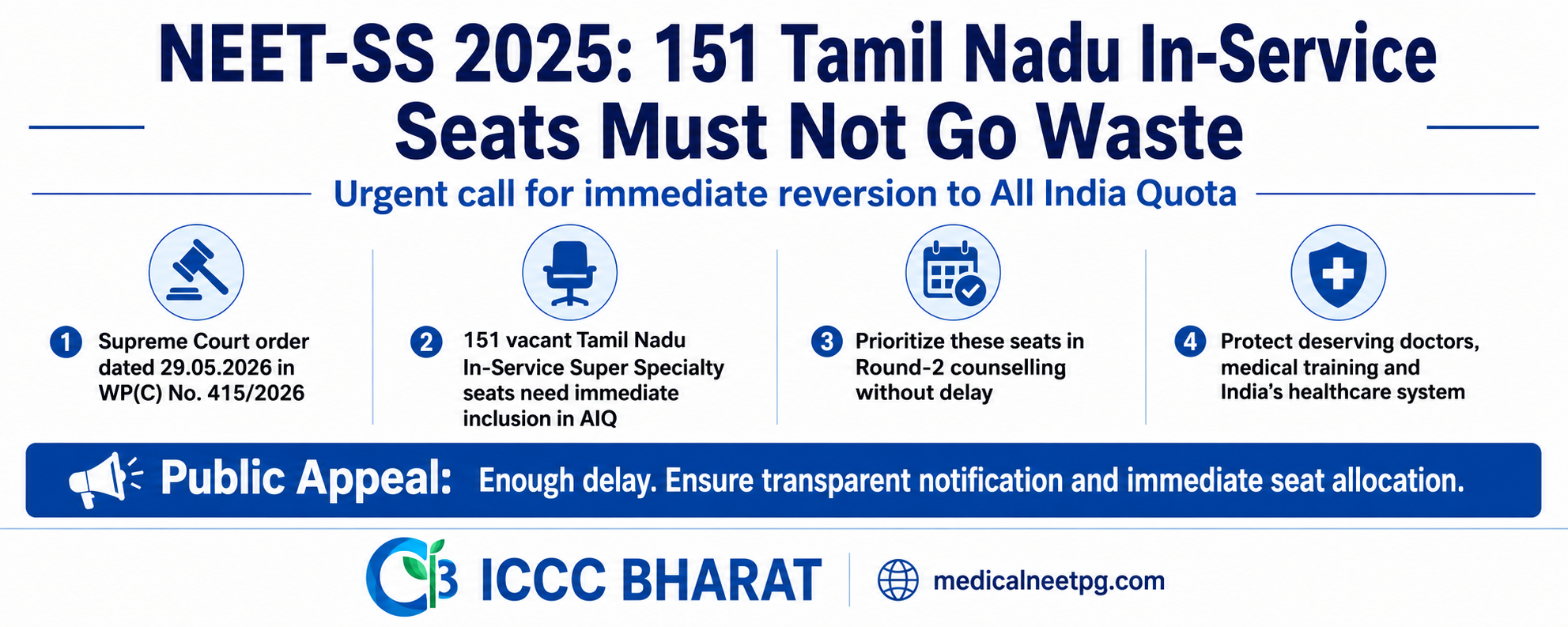
In a sharp escalation, the Federation of All India Medical Association (FAIMA) has submitted a formal representation to the Director General of Medical Counselling Committee (MCC) and the Directorate General of Health Services (DGHS). The issue? The alleged failure to immediately revert 151 vacant Tamil Nadu In-Service Super-Specialty seats back to the All India Quota (AIQ), despite a clear mandate from the highest court in the land.
This is no longer just an administrative oversight. It is a direct blow to meritorious doctors, overburdened hospitals, and a healthcare system desperate for specialists.
The Core Dispute: A Timeline of Wasted Potential
According to the apex body’s representation, the Supreme Court of India—in its order dated May 29, 2026, under WP(C) No. 415/2026—directed the swift reversion of these vacant in-service seats to the All India Quota. Yet, as Round-2 of counselling progresses, these seats remain missing from the active seat matrix.
The math behind the vacancy highlights a massive gap between state allocation and actual utilization:
| Metric | Details (Tamil Nadu SS Seats 2025–26) |
| Total In-Service Seats Allocated | 219 |
| Candidates Who Qualified | ~100 |
| Candidates Who Actually Joined | 68 |
| Unutilized, Vacant Seats | 151 |
By failing to immediately absorb these 151 seats into the All India Quota, the system is actively triggering massive seat wastage—a luxury India’s healthcare system cannot afford.
Seats Are Not Just Numbers: The Real Cost of Inaction
Super-specialty seats are not mere statistics on an administrative ledger. Each single seat represents a future cardiologist, neurologist, nephrologist, oncologist, or critical care specialist.
The Ripple Effect: When one super-specialty seat goes vacant, the country loses far more than a student’s admission. It loses a highly trained clinician who could have treated tens of thousands of critical patients over a 30-year career.
With vast regions of India completely devoid of tertiary healthcare specialists, leaving these seats vacant due to procedural inertia is nothing short of a national loss.
The Human Toll on Qualified Doctors
NEET-SS aspirants are not fresh graduates; they are already fully qualified, practicing postgraduate doctors. To pursue a super-specialty (DM/MCh), many have:
- Resigned from secure government or private hospital jobs.
- Put their clinical careers and earnings on hold for months.
- Uprooted families and prepared for complex interstate relocations.
When authorities drag their feet, these doctors suffer immense financial and mental agony for no fault of their own. Accountability in the system is entirely one-sided: if a candidate misses a registration deadline by five minutes, they are disqualified. Yet, when administrative bodies delay compliance with a Supreme Court order for days, there are zero repercussions.
FAIMA’s Core Demands
To prevent irreversible seat wastage, the medical community has put forth an uncompromising list of demands to the MCC, DGHS, and the Ministry of Health and Family Welfare (MoHFW):
- Immediate Surrender: Instant inclusion of all 151 vacant Tamil Nadu In-Service seats into the All India Quota matrix.
- Judicial Compliance: Strict, literal enforcement of the Supreme Court order without further bureaucratic dilly-dallying.
- Round-2 Prioritization: Immediate deployment of these seats into the ongoing Round-2 counselling phase so eligible candidates can opt for them.
- Absolute Transparency: Issuance of an official, clear notification detailing the exact status of reverted seats to eliminate panic and rumors.
The Broader Impact on India’s Healthcare Infrastructure
This crisis transcends a single state or a single round of counselling. Super-specialists are the backbone of tertiary medical centers, cancer institutes, and emergency trauma units.
Every single seat left vacant results in:
- One less specialist entering the workforce in three years.
- Increased burnout for existing, overworked super-specialists.
- Denial of care to thousands of economically disadvantaged patients who rely on government medical colleges for advanced surgeries.
Conclusion: Enough Excuses, Populate the Seats
The Tamil Nadu In-Service seat deadlock is a litmus test for accountability, transparency, and respect for the judiciary in India’s medical education framework.
The message from India’s medical fraternity to the MCC and DGHS is loud and clear: The era of bureaucratic silence must end. Meritorious doctors have earned their positions through grueling hard work. The seats are vacant, the legal path is clear, and the patients are waiting. The authorities must update the seat matrix and act now.